Coding jars and tubs
Jars and tubs can be marked on a lid, label, base or container wall. The stable coding route depends on material, curvature, product temperature, closure handling, line spacing and the amount of variable information required.
Choose the surface that is easiest to control
A flat label or lid can be simpler to present than a tapered, ribbed or highly curved wall. The best position also has to remain visible after capping, labelling, sleeving and case packing.
| Code position | Possible route | Application checks |
|---|---|---|
| Lid top | Direct inkjet after capping, or coding a controlled lid before application. | Lid material, colour, orientation, flatness, product pitch, capper movement, print distance and downstream contact. |
| Applied label | Thermal inkjet, hot foil or TTO may overprint a label before application; direct coding after application may also be possible. | Label coating, code area, web movement, label position tolerance, ink or ribbon and applicator integration. |
| Container wall | Inkjet selected for the material and geometry. | Curvature, taper, ribs, moulding marks, rotation, surface treatment, moisture, printhead gap and product stability. |
| Base | Inkjet where the line can safely expose and present the bottom surface. | Container support, product tracking, access, print visibility, base profile and inspection-camera position. |
Container handling determines code position
Spacing and rotation
Products need a predictable gap and orientation. Starwheels, belts, guides, screws or side-grip conveyors may stabilise the pack but can also contact the fresh code.
Curvature and print gap
A tight curve changes the distance and angle across the print. Confirm the usable code height and printer mounting with the smallest and largest container.
Temperature and surface state
Cold-fill, hot-fill, washing, oil, powder or condensation can alter adhesion and drying. Trial the real process state, not only a clean ambient container.
Decide between direct coding and label overprinting
Direct marking can remove an extra label for a short code, while an existing label can provide a controlled high-contrast surface.
- Compare code area and readability on the container and label.
- Check whether label artwork or position varies between SKUs.
- Include label-web speed and applicator timing if coding before application.
- Assess rework when the direct code or label is incorrect.
- Test adhesion and scanner performance after product cooling and handling.
Use the correct inkjet route
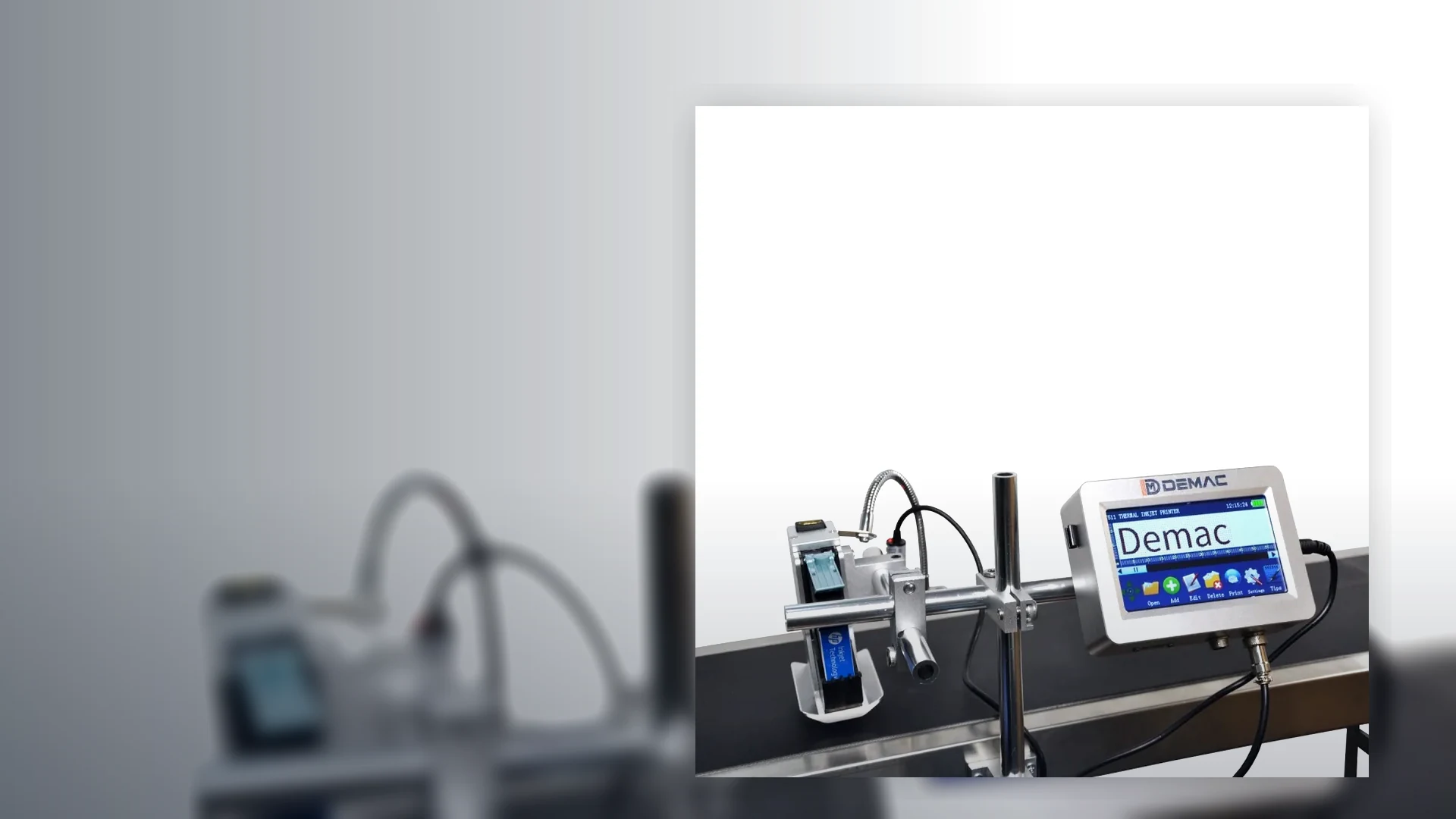
The verified J511 thermal inkjet can be assessed for consistently presented surfaces and suitable inks. Curved, irregular or faster container applications may need broader continuous inkjet technology.
Compare the J511 TIJ information with Lancing's wider inkjet coding range rather than forcing one technology.
Jar and tub coding trial
All formats
Use the smallest and largest container, each material, colour, lid and label variant.
Full message
Test dates, batches, logos and machine-readable codes at the final size and orientation.
Real line state
Reproduce fill temperature, condensation, spacing, rotation, speed and downstream contact.
Finished-pack check
Inspect after capping, labelling, sleeving, accumulation and case packing as applicable.
Information for a jar or tub coding quotation
Send container, lid and label drawings or dimensions, plus samples of every important material and colour. Mark preferred and unacceptable code areas.
Provide the product path from filler or capper to labeller and case packer, showing guides, belts, accumulation and available mounting space. Include a short video at normal production.
State product temperature, moisture, oil, powder, cleaning or condensation conditions at the proposed print point. Include the time before the code contacts another surface.
Supply the full message, changeover pattern, data source, inspection requirement and the response required when a code is wrong, missing or unreadable.
Sequence coding around capping and labelling
The coding point should be selected as part of the complete container sequence, not as an isolated printer position. A lid code applied before capping needs reliable lid orientation and protection through the capper. A side-wall code applied before labelling must remain outside the label footprint, while a code applied after labelling depends on label position and web-to-container registration.
Before closure
Confirm how the lid or container is detected, how the approved message is associated with the product and how incorrectly coded components are contained before assembly.
After closure
Check capper contact, torque heads, guides and transfer belts so the new code is not rubbed, hidden or moved outside the inspection field.
After labelling
Challenge label-position variation, container rotation and artwork contrast. Prove that the camera or operator can still read the complete mark at normal line conditions.
Jar and tub coding FAQs
Where can a date code be printed on a jar or tub?
Common positions include the lid, base, side wall, applied label or sleeve. Select a location that is consistently presented, visible to the user and protected from downstream abrasion or condensation.
Can thermal inkjet print directly onto plastic tubs?
It may be suitable with an ink intended for the specific plastic and production condition. The surface, print distance, drying, adhesion and downstream handling must be tested on production samples.
Is CIJ better for curved jars and tubs?
CIJ is often assessed for moving, curved or irregular containers because of its non-contact application window. The model, ink, print position and line presentation still need verification.
Can the lid be coded before it is applied?
Yes, where lids can be fed and presented consistently before capping. The project must control lid orientation, code position, data association and handling after printing.
What should be sent for a jar or tub coding trial?
Provide empty and representative filled containers, every lid and label variant, the full message, line video, normal and maximum output, product temperature and details of washing, cooling or condensation.
Find the most stable code position on the container
Send jars or tubs, lids, labels, the full code and a line video so Lancing can assess presentation and ink or label routes.