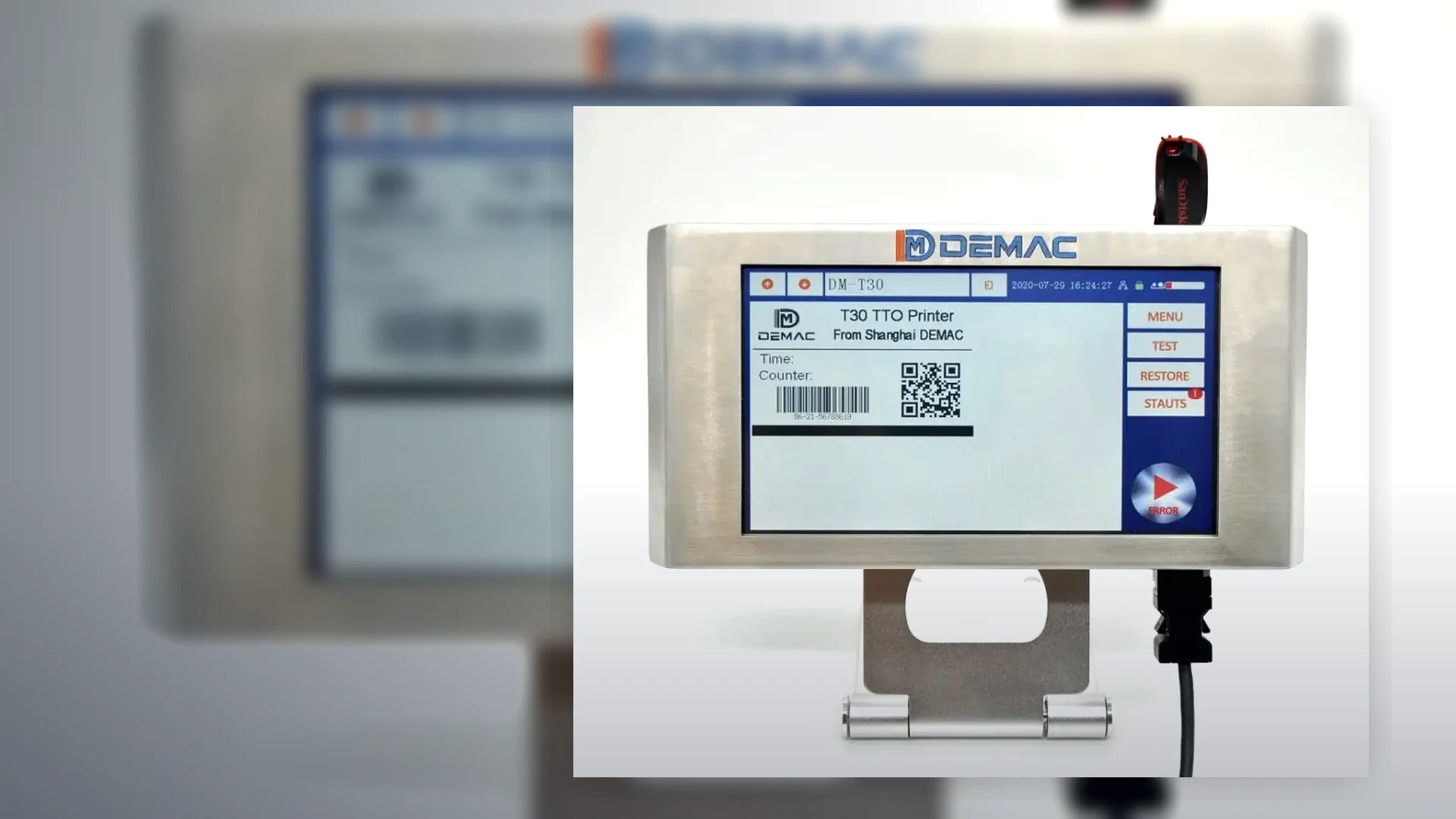
Coding machine FAT, SAT and commissioning
Factory and site acceptance should prove the complete coding duty under agreed conditions. A single attractive sample does not demonstrate job control, line timing, inspection, reject handling or recovery from faults.
Start with an acceptance plan, not a demonstration agenda
The plan should trace each important requirement to a test, sample, result and owner. It should also state which conditions cannot be reproduced until the machine reaches site.
Before FAT
Freeze the current scope, approved samples, message files, interface assumptions, test quantities, speeds, responsibilities and open items. Confirm that test consumables match the proposed production combination.
At FAT
Prove the machine configuration, print result, job control, normal sequence, planned changeover and controlled faults that can be safely reproduced before shipment.
At SAT
Confirm utilities, mounting, real line movement, final controls, production materials, operator access, downstream handling and any test deferred from FAT.
Acceptance phases and evidence
| Phase | Typical purpose | Useful evidence |
|---|---|---|
| Application trial | Establish a credible printer, ink or ribbon and material combination before final configuration. | Identified sample, full message, settings, consumable, movement, drying or cooling time and agreed visual or measured checks. |
| Design review | Confirm scope, layout, access, interfaces, risks, utilities and acceptance method. | Approved drawing, responsibility matrix, I/O schedule, message schedule, risk actions and test plan. |
| FAT | Check build, configuration and repeatable operation before shipment. | Signed test script, printed samples, job list, settings, fault challenges, deviations and action owner. |
| Installation | Place the equipment safely and connect the agreed services and interfaces. | Installation check, utility confirmation, cable and guard inspection, software or configuration version and open-item list. |
| SAT and commissioning | Demonstrate the coding station on the production line with representative users and materials. | Production run, changeover, data and inspection checks, fault recovery, sample approval, training and handover record. |
FAT tests for the complete message and sequence
The exact script depends on the machine and contract, but the following categories expose common gaps.
- Load every agreed product job and confirm the correct human-readable and machine-readable content.
- Run the largest message and demanding print orientation on the identified production substrate.
- Check normal start, planned stop, restart, product gaps and any agreed speed change.
- Complete a representative product and message change using the intended operator procedure.
- Replace the relevant cartridge, ribbon or type and repeat first-off approval.
- Challenge data, sensor, encoder, printer-ready, inspection and reject conditions that are included in the supplied system.
Do not confuse print command with print proof
A “print complete” or ready signal can confirm the printer's internal state, but it does not necessarily prove that the physical mark is present, correct and readable. Where that proof is required, define a scanner, camera, sample check or other inspection method and its limitations.
The vision inspection and reject guide separates code presence, OCR/OCV, barcode decoding and formal verification.
SAT tests that depend on the real production line
Site acceptance should close the gap between a controlled factory test and the actual pack, environment and machine sequence.
Line movement
Real conveyor or web speed, product pitch, acceleration, gaps, vibration, registration and upstream or downstream interactions.
Environment
Temperature, humidity, washdown boundary, dust, vapour, condensation, lighting and the actual state of the print surface.
Interfaces
Final PLC signals, data source, job selection, network behaviour, alarms, reject device, tracking and reset sequence.
Operations
Production users, first-off check, changeover, cleaning, consumables, routine fault response, records and escalation path.
Commissioning handover checklist
Approved jobs and samples: retain the final files, message rules, substrate identity, consumable and representative accepted print. Record any variants not tested.
Settings and software: back up printer jobs, controller parameters, PLC or vision configuration and the version approved at handover using the site's own control process.
Documents: provide the agreed manuals, drawings, I/O schedule, maintenance instructions, consumables list, critical spares and support contacts.
Training: cover start-up, job selection, first-off approval, changeover, cleaning, consumable replacement, routine alarms and the point at which production should stop and escalate.
Open items: identify owner, target date, temporary control and impact on acceptance. Do not allow an informal verbal action list to replace a controlled record.
Post-start review: where included, review real consumable use, false rejects, code defects, operator feedback and any gap between the trial conditions and normal production.
FAT, SAT and commissioning FAQs
What is the difference between FAT and SAT for a coding machine?
FAT is normally completed before shipment at the agreed test location, while SAT confirms installation and operation on the production site. The exact scope should be agreed in the contract and acceptance plan.
Can FAT be completed without production samples?
A basic functional check may be possible, but print suitability cannot be proven without representative material, the full message and realistic movement. Any limitation should be recorded as an open item for SAT.
What coding faults should be challenged?
Typical controlled challenges include printer not ready, low consumable, missed trigger, invalid data, communications loss, unreadable or missing code, reject failure and recovery after a stop. Only test functions that are actually included.
Should maximum speed be tested?
The agreed production condition should be tested with representative product spacing and the full message. The test method and duration should be defined rather than relying on a brief no-load demonstration.
What should be handed over after commissioning?
The agreed package may include manuals, approved jobs, settings backup, drawings, interface schedule, test records, sample approvals, maintenance information, spare-parts list and training records.
Define acceptance before the coding machine is built
Send the URS, sample pack, message list, line details and proposed tests. Lancing can use them to align the quotation, trial and handover scope.